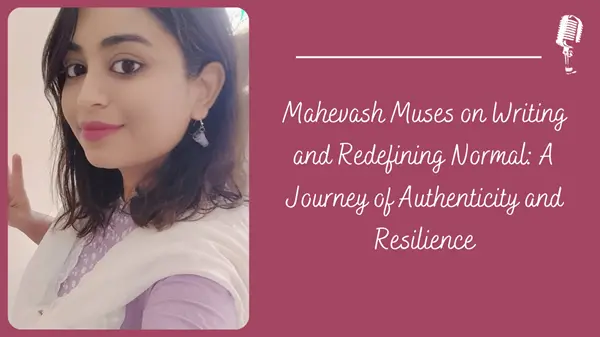

In a digital world that often rewards perfection and performative positivity, Mahevash Muses has carved out a refreshingly honest corner of the internet. Through deeply personal storytelling and unfiltered conversations about mental health, culture, work, and identity, Mahevash Muses - writer, blogger, and mental health advocate - invites readers to sit with discomfort, question societal norms, and embrace authenticity over approval. From her early love of writing and an unexpected start as an IT engineer to navigating divorce, therapy, and life with anxiety and depression, Mahevash’s journey is one of resilience, self-expression, and radical honesty making her voice not just relatable, but necessary.
In an era dominated by polished feeds and performative perfection, your writing stands out for its raw honesty. What led you to choose vulnerability and truth as the foundation of Mahevash Muses?
Mahevash: I’ve always been an intense, opinionated person. Growing up, I dealt with constant pressure to fit into society’s narrow definition of “normal”. Going to school and being around people my age was suffocating, and I was free to be myself only at home and in select places like bookstores, coffee shops, and, of course, the World Wide Web.
When I started Mahevash Muses on February 17, 2015, I wanted to build a place where people like me—those who feel deeply, question convention, and don’t fit the mold—could breathe easy. Blogging became my way of connecting with them while expressing myself. Over time, it also became a way to push back against the toxic culture of curated perfection. For me, raw honesty is both connection and quiet resistance.
Looking back at your early years, you made a pivotal deal with your father to follow a conventional path through engineering before fully pursuing writing. How did navigating that compromise shape not just your career, but the writer and person you became?
Mahevash: I had no interest in IT engineering, and got my engineering degree only for my father’s sake. As a loving parent, he was worried that I would not be able to make it as a creative. Having to wait for years before I could pursue writing made me fiercely protective of it.
Those years taught me discipline, patience, and a deep respect for the craft. When you have to fight for something you love, you don’t treat it casually. I think that’s why my writing is unapologetically direct. I value clarity, and I don’t believe in wasting emotional or intellectual energy, whether it’s mine or or the reader’s.
Building on that personal journey, your blog has become a safe space for conversations people often avoid. From behind a screen, how do you cultivate trust and safety with your readers, especially around topics that are deeply personal or uncomfortable?
Mahevash: I show my readers what it looks like to be vulnerable. I talk about things people usually hide, like the fear of not being good enough, divorce, intrusive thoughts, and social media comparison.
I write like I’m talking to a friend over coffee. There’s no preaching or pretending to have it all figured out. Safety comes from feeling seen without judgment, and that’s the tone I try to set in every blog post and social media update. When people feel seen rather than analyzed, trust follows naturally.
You’ve been candid about living with generalized anxiety and double depression, subjects still surrounded by stigma. How has sharing these diagnoses reshaped your relationship with your own mental health, and how has it deepened your connection with your audience?
Mahevash: Living with chronic mental illness often comes with a great deal of internalized shame. Writing openly about my diagnoses slowly stripped that shame of its power. Naming things honestly made them less frightening and less isolating. It also transformed my relationship with my audience. Instead of simply consuming my content, readers began responding by sharing their stories, fears, and coping mechanisms. I hold their trust with care because I know how hard it is to open up about mental health struggles.
Personal symbols can carry profound meaning, and your semicolon necklace has become a recognizable one. What does the semicolon represent in your story, and how does it continue to guide or remind you in your journey?
Mahevash: The semicolon became a symbol of strength through Amy Bleuel, the founder of Project Semicolon. The symbol is deeply personal to me, and I live by this quote by Amy: “A semicolon is used when an author could’ve chosen to end their sentence, but chose not to. The author is you, and the sentence is your life.”
As someone who experiences suicidal ideation, my semicolon necklace reminds me that my story is still unfolding and is far from over.
Beyond your personal narrative, you’ve become a leading voice on mental health in India. Since launching Mahevash Muses in 2015, how have you seen public conversations evolve, and what gaps still need to be addressed?
Mahevash: In 2015, talking about mental health in India invited incessant judgment and cruel labels. Today, people are more empathetic and willing to acknowledge the legitimacy of mental health issues like anxiety, depression, OCD, PTSD, and so on. Therapy isn’t the taboo it once used to be.
That said, mental health stigma hasn’t disappeared. Good therapists are still hard to access. especially outside big cities. Most of us still tend to romanticize or trivialize mental health. The work ahead is normalizing the boring, everyday part of mental health—such as maintenance, boundaries, rest—not just crises. We need to understand that ‘mental health matters’ is more than just a hashtag or a popular phrase. It’s an undeniable fact.
Shifting slightly to craft, you’ve spent years both asking and answering questions as an interviewer. In your view, what defines a truly great interview, and how has being on the other side of the questions shaped your approach on your own blog?
Mahevash: A great interview is rooted in curiosity. It’s when the interviewer is genuinely interested in knowing more about the interviewee, not just extracting sound bites.
Being interviewed has made me more intentional with my questions. I try my best to make people feel comfortable by asking questions that allow nuance and don’t assume anything about their lives. I appreciate thoughtful questions as an interviewee, so I always make it a point to be thoughtful as an interviewer.
Similarly, when you pick up a book to review, what draws you in first? Are there particular qualities ,voice, authenticity, narrative depth, that you’re always hoping to encounter?
Mahevash: Authenticity is always the first thing I look for. It’s easy to know if a writer is telling the story they had to tell or the story they thought they should tell.
Of course, voice and structure and depth of character matter. But what I’m always hoping to find is something real that stays with me long after I turn the last page and, to some extent, reshapes how I see the world.
Your writing is also a testament to navigating life’s turbulence. What does your personal writing ritual look like, and how do you find your way to the page on difficult days?
Mahevash: My writing ritual is simple: to show up exactly as I am. On some days, I’m a disciplined writer with notes and outlines. On some days, I’m just a tired human trying to string together some coherent sentences. Either way, I try to sit with how I’m feeling and let it guide my work instead of fighting it.
On difficult days, I tell myself that I only have to write honestly. Removing the pressure to write well also helps me overcome writer’s block.
Through all these reflections, your blog communicates a message to those who may feel 'too much' or out of place. If you could distill the heart of Mahevash Muses for them, what would you hope they take away?
Mahevash: If you feel like you’re too much or that you don’t fit in anywhere, know that there’s nothing wrong with you. Accept and cherish your intensity and personality, irrespective of what other people think. Remember: even diamonds have flaws!
Finally, you’ve spent years challenging societal expectations and questioning what “normal” means. Today, what does redefining normal mean to you, and where do you hope to take this mission next?
Mahevash: For me, redefining normal means challenging society’s definition of what’s normal and what isn’t. It means making space for people who don’t fit the mold, including myself.
My mission is to make it easier for people to be unapologetically true to themselves. Through my books, blog, and conversations, I hope to keep expanding what “normal” looks like.
Through her words, Mahevash Muses reminds us that authenticity is not only a personal act; it’s a quiet revolution. From challenging societal expectations to creating spaces for honest conversation, she shows that life’s turbulence can be met with clarity, courage, and creativity. Whether through her writing, her blog, or her ongoing dialogue with readers, Mahevash continues to expand the definition of normal, encouraging everyone to embrace their intensity, imperfections, and unique stories. Her message is simple, yet profound: it’s okay to be real, to be flawed, and to keep writing your own sentence because your story is far from over.
For more inspiring stories and interviews from the literary world, check out Amaranth Magazine.